
Short Course
Researching the Paranormal:
Introducing Qualitative Research Skills for Beginners
Dr Jack Hunter
Alister Hardy Religious Experience Research
Centre,
Sophia Centre for the Study of Cosmology in
Culture,
University of Wales Trinity Saint David
Have you ever wanted to research paranormal phenomena but are not sure how to start?
This innovative course, presented in partnership with the Sophia Centre Press and the Sophia Centre at the University of Wales Trinity Saint David gives
- - an introduction to paradigms and approaches in paranormal research and
- - a foundation in qualitative research methods for the study of the paranormal, and other forms of extraordinary experience - from encounters with UFOs to psychedelic experiences and mystical states
Qualitative research relies on experiential and cultural approaches - anthropology, religious studies, consciousness studies, folklore studies – and employs ethnographic methods, including the use of surveys, interviews and participant observation, rather than statistics. It places emphasis on lived experience and explores the meaning of extraordinary experiences for those who have them.
Over the course of five live seminars we will introduce the theory and methods of qualitative research with a particular emphasis on using these methods for researching the intersections of spirituality, culture, experience and the paranormal.
Each seminar will include space for questions and discussion. Optional reading will be provided but there will be no required course work.
If you would like to talk about a research project then we will provide space in weeks 4 and 5, subject to time.
There will also be a Forum for posting ideas and thoughts in between seminars.
1. Theoretical and Methodological Issues
- a)
Quantitative and Qualitative Research
- b)
Hard Problems of Consciousness and Subjectivity
- c)
Data and Damned Facts
This week deals with some of the broader paradigmatic and theoretical issues related to conducting research, including the differences between quantitative and qualitative approaches, issues to do with the nature of consciousness and our means of investigating subjectivity, as well as the limits of our current paradigms.
2. Psychical Research and Parapsychology
- a)
Origins and Precursors
- b)
Psychical Research
- c)
Parapsychology
- d)
Developments, e.g. anomalistic psychology, ghost
hunting, and son on.
This week will give an introduction to paranormal research from its earliest origins, through the emergence of psychical research in the nineteenth century, laboratory-based parapsychology in the twentieth century, as well as more recent developments, such as in the popular field of ghost hunting, and in academic fields such as anomalistic psychology. We will evaluate the strengths and limitations of different approaches to paranormal experiences.
3. Religious Experience Research
- a)
Origins
- b)
Pioneers
- c)
Recent Developments
This week focuses on academic religious experience research, tracing the development of the field from the earliest theological approaches, into the work of key scholars such as William James, Rudolf Otto and others. We will also consider more recent development, especially through the lineage of Sir Alister Hardy’s approach to researching religious and spiritual experiences. We will evaluate the strengths and limitations of different approaches to the study of religious and spiritual experiences.
4. Phenomenological Methods
- a)
Recent Developments
- b)
Ethnography and Autoethnography
- c)
Surveys, Interviews and Comparison
- d)
Ethical Considerations
This session considers the practicalities of conducting research on extraordinary experiences, including experience-centred approaches, ethnographic approaches, participant observation and autoethnography, as well as practical tips on conducting surveys, carrying out interviews and comparative analysis. We will also consider a range of ethical issues in conducting qualitative research.
5. Further Reaches and Ontological Flooding
- a)
High Strangeness and the Deep Weird
- b)
Decolonising Research Methods
- c)
Ontological Implications
The final seminar will consider the further reaches of extraordinary experience research, exploring high strangeness experiences - through the ideas of J. Allen Hynek, Charles Fort and others - and will consider the value of exploring approaches and methodologies that draw on different ontological assumptions for researching the paranormal. Decolonised research methods may provide one way of moving paranormal research beyond its current paradigms to explore other ontological possibilities.
Bio
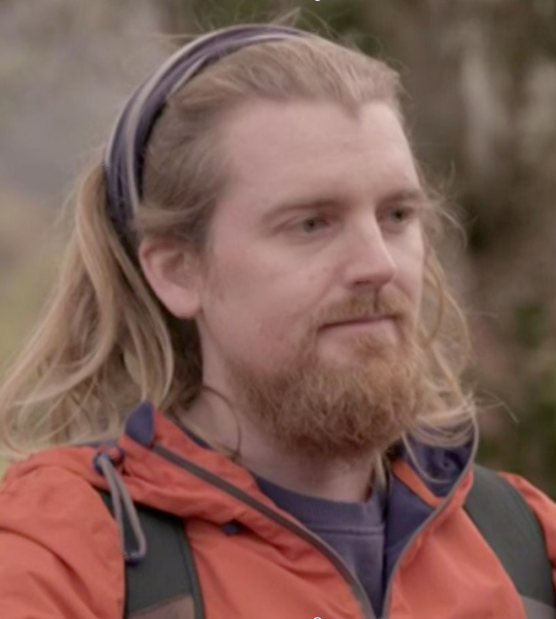
Jack Hunter, PhD., is an anthropologist exploring the borderlands of consciousness, religion, ecology and the paranormal. He is an Honorary Research Fellow with the Alister Hardy Religious Experience Research Centre, University of Wales Trinity Saint David, and a tutor at the Sophia Centre for the Study of Cosmology in Culture, University of Wales Trinity Saint David. He teaches on the MA in Ecology and Spirituality and the MA in Cultural Astronomy and Astrology. He is also a tutor for the Alef Trust on their MSc in Consciousness, Spirituality and Transpersonal Psychology, where he teaches on the Approaches to Consciousness module. He is the author of Manifesting Spirits (2020), Spirits, Gods and Magic (2020) and Ecology and Spirituality (2023), editor of Deep Weird (2023), Greening the Paranormal (2019) and Damned Facts (2016), and co-editor of Talking With the Spirits (2014), Mattering the Invisible (2021), Folklore, People and Place (2023) and Sacred Geography: Conversations with Place (2024). He lives in the hills of Mid-Wales with his family.
Dates
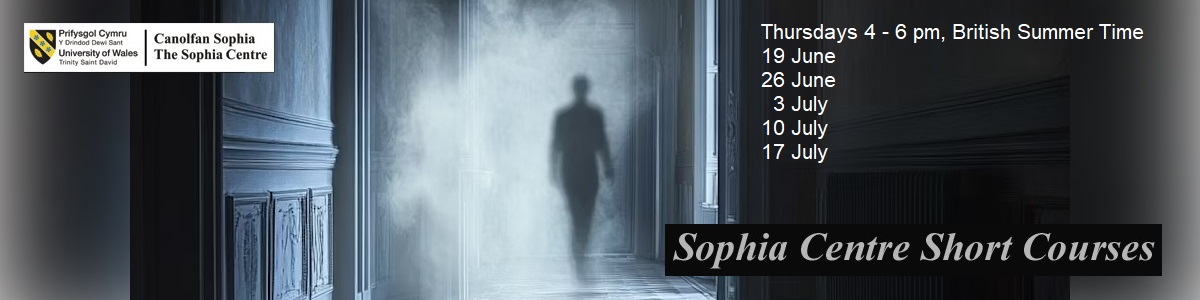
All seminars will run from 4 pm to 6 pm British Summer Time
1. Thursday 19 June
2. Thursday 26 June
3. Thursday 3 July
4. Thursday 10 July
5. Thursday 17 July
Recommended Texts
The following books provide background for the course and highlight Jack’s work in the area. They are available from all online bookshops. The links below are to Amazon UK but try your favourite outlet.
Jack Hunter (2018), Engaging the Anomalous: Collected Essays on Anthropology, Mediumship, the Paranormal and Extraordinary Experience. Milton Keynes: August Night Press.
Buy in the UK
Jack Hunter (2020). Spirits, Gods and Magic: An Introduction to the Anthropology of the Supernatural. Milton Keynes: August Night Press.
Buy Amazon UK
Jack Hunter (2023). Deep Weird: The Varieties of High Strangeness Experience. Milton Keynes: August Night Press.
Buy Amazon UK
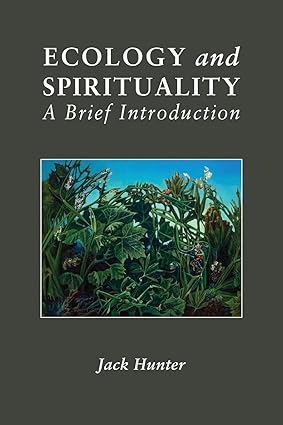
Jack Hunter (2023). Ecology and Spirituality: A Brief Introduction (Lampeter: Sophia Centre Press, 2023).
Buy Amazon UK
Registration
The cost which covers all five lectures is £150.
Students and graduates of the University of Wales Trinity Saint David can enrol at the University rate of £120.
By registering I agree to follow the Sophia Project netiquette guide.
To register and pay, please click the link to www.eventbrite.com.
The acknowledgement of payment from Eventbrite will be sent to the email address that you have registered with Eventbrite. The day before the course starts, the link to join the seminar will also be sent to this address. If you wish the link to be sent to a different email address, please contact sophiacentre@sophia-project.net.
You should register by Eventbrite if possible but, if you can't, email Dr Nick Campion at n.campion@uwtsd.ac.uk and you can arrange to pay by cheque or bank transfer.
Terms and Conditions
Fees and Refunds – Fees must be paid in full before the commencement of the course. Refunds will be made if students withdraw from the course before it commences. There are no refunds after students log into the Course Moodle page, which is opened up two days before the course begins.
Forum conduct - All students are expected to follow the netiquette guide and be respectful of other students and the tutor in their forum posts. The course tutor will remove any postings they consider to be inappropriate. The course tutor also reserves the right to block a student from posting on the forums if the student disregards a request by the tutor to revise their forum conduct.
Zoom conduct – Students attending the Zoom lectures live are expected to be focused on these lectures and only use the chat box for question directed at the lecture material. Students who misuse the chat box will be removed from the lecture.
Technology – It is the student's responsibility to ensure that they have sufficient broadband and sufficient skills in operating their computer or tablet to enable them to engage with this online course.
Sophia Centre Short Courses are taught as part of our outreach programme from the University of Wales Trinity Saint David. If you would like to take your studies further, you may apply for our unique, on-line, fully accredited Master's programme in Cultural Astronomy and Astrology, the only academic programme in the world to look explore our relationship with the sky, and the history, philosophy and culture of astrology.


Welcome to the public outreach page of the Sophia Centre for the Study of Cosmology in Culture at the University of Wales Trinity Saint David, with information about studying with the University, as well as links to related conferences, classes, publications and events. To go straight to the Sophia Centre's University page please go here.
Please follow our guidelines on Netiquette.
Click the link below to join our mailing list to keep informed of Sophia Centre events:
Mailchimp
Upcoming Events
2027
11-12 May,
Sophia Centre
Annual conference 2027
8-10 May,
Sophia Centre
Summer School 2027
2026
16 Jun,
Alumni lecture
Berna Lee